Showing posts with label Book Review. Show all posts

22 January 2009

Book Review: Hungry Planet

I have a new obsession: the book Hungry Planet: What the World Eats by Peter Menzel and Faith D'Alusio. I had seen these photographs before: families from countries around the world photographed with a week's worth of food. They include photos like this one, from India:

This one, from the United States (Texas):

And this one, from Mali:


You can see more of the photos here and here.

But I really recommend getting your hands on the book; check your local library. In addition to the photographs and captions--which break down the total amount of money spent on food weekly, by food groups--the book also includes essays about each family included in the book and statistics about each country. There are also essays by such luminaries as Michael Pollan, plus recipes from each of the countries.

On one level, this book is a visual feast, a foray through countries and cultures. (In addition to the photographs of individual families, there are tons of gorgeous photos from each featured country.) But on a deeper level, this book is also a dip into some big and crucial global issues: global inequity in the distribution of resources, the very real existence of hunger in people's daily lives, the global coexistence of malnutrition and overnutrition, and the way changing eating patterns and food-marketing patterns are contributing to an increase in diseases like diabetes and cancer. It's eye-opening to think about where each of us would fit into this global portrait, and what that really means.

11 January 2009

Book Review: Mountains Beyond Mountains


I have a new hero; his name is Paul Farmer. After reading this book by Tracy Kidder (the full title is Mountains Beyond Mountains: The Quest of Dr. Paul Farmer, a Man Who Would Cure the World, I have a sense of Paul Farmer as being a kind of edgy, smart-alecky Mother Teresa. With his medical degree from Harvard and a lifelong interest in liberation theology and social justice issues, Farmer established Partners in Health, a non-profit dedicated to providing a preferential option for health care for the poor. Farmer also founded Zanmi Lasante, a health clinic in a poor rural area in Haiti. He is this incredibly intense, focused, and passionate character who has literally given all he has to improving health in less-developed countries. Plus--and I love this--the book describes his efforts to merge medicine and anthropology, in the quest to provide improved health outcomes while still respecting cultures and identities and beliefs. Farmer has done more in his lifetime than I can even comprehend, and Mountains Beyond Mountains takes you around the world with him, from Peru to Russia.

After reading Mountains Beyond Mountains, I am definitely planning on reading some of the books that Farmer has authored (like this one and this one), but I recommend Mountains Beyond Mountains. It's a good introduction to public health issues (particularly tuberculosis and AIDS), and provides a really compelling picture of the way economic inequality translates into increased risk of illness and death for the poor.

By the way, if you live in the Boston area, Dr. Farmer will be speaking at Boston University on January 19 for Martin Luther King Jr Day. Click here for more details about the event. Maybe I'll see you there...

05 January 2009

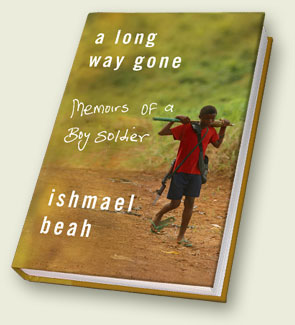
Book Review: A Long Way Gone


This week I read Ishmael Beah's book A Long Way Gone: Memoirs of a Boy Soldier. I really recommend it; it is hard to read, but I think the international community owes it to Beah to read this book, get sensitized, and then get passionate and angry about the fact that children are being used as soldiers in numerous conflicts around the world.

This book provides an up-close look at the plight of child soldiers in the civil war in Sierra Leone (which ended in 2002). The conditions described can probably be generalized to many other child soldiers as well. In the 1990s, Sierra Leone was embroiled in a brutal civil war that resulted in the deaths of tens of thousands of people, and displaced more than one-third of the country's population. Both government forces and armed rebel groups recruited and forcibly conscripted children into their armed forces. (This practice continues in a number of ongoing conflicts today--see here, here and here for examples.)

When Beah was thirteen years old, he was conscripted into the national army, and went through "training" to become a soldier. Aside from the training in weapons, the children received a steady diet of drugs and Rambo movies (something that makes me feel really ashamed of Hollywood), and then they were thrust into combat and instructed to kill "anything that moved." Symptoms of post-traumatic stress were treated with cocaine and marijuana. For several years, Beah traveled with the army, attacking villages and rebel camps, and killing people in brutal ways. I can't imagine how painful it must have been for Beah to revisit these events in order to write the book. He doesn't flinch. He tells the truth.

At age 16, Beah was removed from the army by UNICEF and placed in a rehabilitation center. After a challenging rehabilitative period, Beah's path took him to testify before the United Nations, meet with international conferences of youth, and ultimately live in the U.S. and attend college here. It's clear, reading the book, that Beah is a naturally gentle and forgiving spirit, and one of the messages of the book is that under certain circumstances, all people are capable of great acts of brutality. Also, under certain circumstances, we are all capable of reclaiming our humanity.

In the end, A Long Way Gone is a harrowing look at the horrific treatment of children involved in conflict situations --and a graphic and heartbreaking look at war in general-- but it is also a story about hope and the power of rehabilitation. In Beah's words, from an occasion when he spoke before the UN Economic and Social Council: "I have been rehabilitated now, so don't be afraid of me. I am not a soldier anymore; I am a child. We are all brothers and sisters. What I have learned from my experiences is that revenge is not good... If I am going to take revenge, in that process I will kill another person whose family will want revenge; then revenge and revenge and revenge will never come to an end."

You can read more about Beah and the book on his website. I was also interested to read the perspective of the New York Times book review.

15 December 2008

Book Review: Africa: Altered States, Ordinary Miracles


"Every time you say 'Africa is…' the words crumble and break. From every generalisation you must exclude at least five countries… Africa is full of surprises." (Richard Dowden)

This book is phenomenal, and I recommend it to anyone who is trying to deepen their understanding of the African continent. Richard Dowden is a journalistic veteran; he's spent over 30 years writing about Africa for several prominent British publications. From the outset of this book, Dowden acknowledges the impossibility of providing a comprehensive survey of Africa, but in my opinion this 554-page tome is a good attempt. Most of his chapters deal with specific countries: Uganda, Somalia, Senegal, Nigeria, South Africa, Sierra Leone, Burundi and Rwanda, etc. He also deals with continent-wide issues like AIDS, colonialism, and neocolonialism. Colonialism is an ongoing theme in the book. I've long had the sense that many of the current problems in various regions of Africa can be traced back to the abuses and travesties of colonial history, and this book definitely reinforced that idea for me.

My dad sent me this book after reading that Chinua Achebe (whose work I adore) wrote the Foreward. In Achebe's words, "The triumph of the written word is often attained when the writer achieves union and trust with the reader who then becomes ready to be drawn deep into unfamiliar territory, walking in borrowed literary shoes so to speak, towards a deeper understanding of foreign peoples, cultures and situations. Richard Dowden's [book] succeeds marvelously." High praise indeed.

One of my favorite chapters of the book is the chapter on Zimbabwe. Dowden first met Robert Mugabe back in 1976, when he was still a revolutionary freedom fighter, and Dowden's explanation of Zimbabwe's history really helped me understand recent events there. Likewise with the chapters on Sudan and the Congo; in fact, I drew heavily on the information from this book when I wrote my blog posts on those two countries. And of course, anyone who knows me is aware of my affinity for former-colonies of Portugal, so I enjoyed the section on Angola and wished he'd included Mozambique as well.

According to The Economist's book review, Dowden's book focuses on "two questions: why is development so slow in Africa? And how, in the midst of so much savagery, does the humanity of Africans survive as one of the continent’s defining characteristics?" I can think of other wonderful books that have attempted to answer the first question (like Guns, Germs and Steel, and The End of Poverty). But Africa approaches it from a slightly different angle, with an eye bent toward history and toward the agency of individual people. I loved Dowden's prose for its honesty. He is unflinching in describing the horrors of wars and famines that he has witnessed in Africa, and not afraid to indict specific people for the role they've played in the collapse of communities, but at the same time there is no doubt how much he admires individual people and whole cultures that he has met and lived with in Africa. In his words:

"Westerners arriving in Africa for the first time are always struck by its beauty and size--even the sky seems higher. And they often find themselves suddenly cracked open. They lose inhibitions, feel more alive, more themselves, and they begin to understand why, until then, they have only half lived. In Africa the essentials of existence--light, earth, water, food, birth, family, love, sickness, death--are more immediate, more intense. Visitors suddenly realize what life is for. To risk a huge generalization: [In the West], amid our wasteful wealth and time-pressed lives we have lost human values that still abound in Africa."

That passage sounds a little like he might fall into the trap of romanticizing and exoticizing Africa... but for the most part he doesn't. (This particular passage describes something that I felt frequently, though certainly not always, when I lived in Mozambique.) He gives a clear-eyed look at a complicated continent, and it is one fantastic read.

(And I can't finish this review without mentioning one thing. See the boy holding the soccer ball on the cover of the book? My one-year-old daughter is obsessed with him. She carries this book --heavy as it is-- around the house with her, pointing to him and saying her version of the word "friend" over and over, and sometimes she kisses him. Maybe it's the way he looks straight out at you, nothing in his eyes but self-ness. This photo has a strong effect on me as well; I think it's a great picture. But whatever the reason, my daughter loves him.)

You can read other reviews of Africa: Altered States, Ordinary Miracles here and here.